National Security
America's Mining Workforce Crisis Is Becoming a National Security Risk
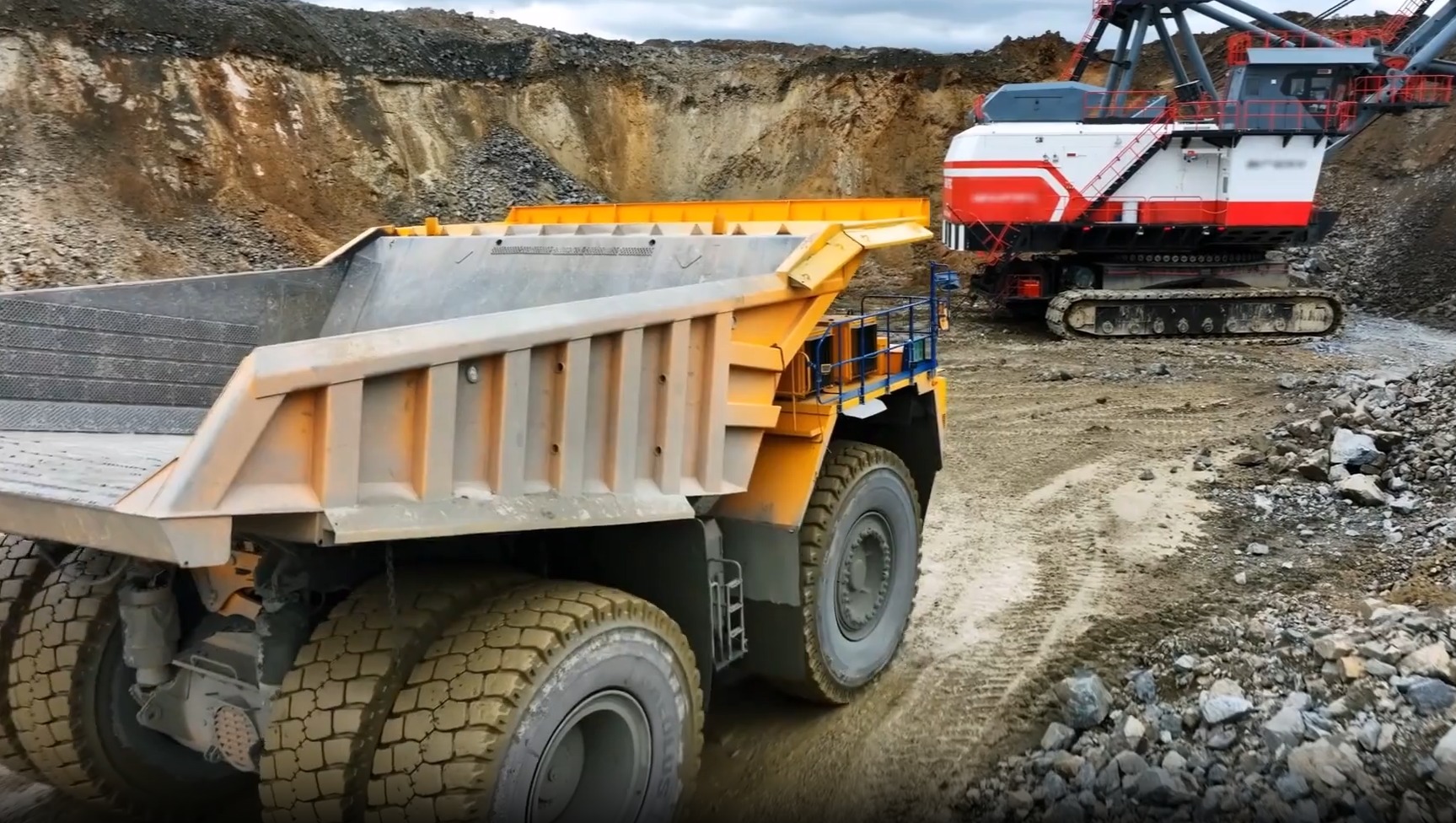
The United States is entering an era defined by electrification, artificial intelligence, advanced manufacturing, and strategic competition over critical minerals. Copper, lithium, nickel, graphite, rare earths, and other mined materials sit at the foundation of modern life—powering electricity grids, data centers, electric vehicles, defense systems, and industrial production.
Yet beneath the policy debates around permitting, reshoring, and supply chains lies a deeper and more dangerous vulnerability:
America is running out of the people who know how to mine.
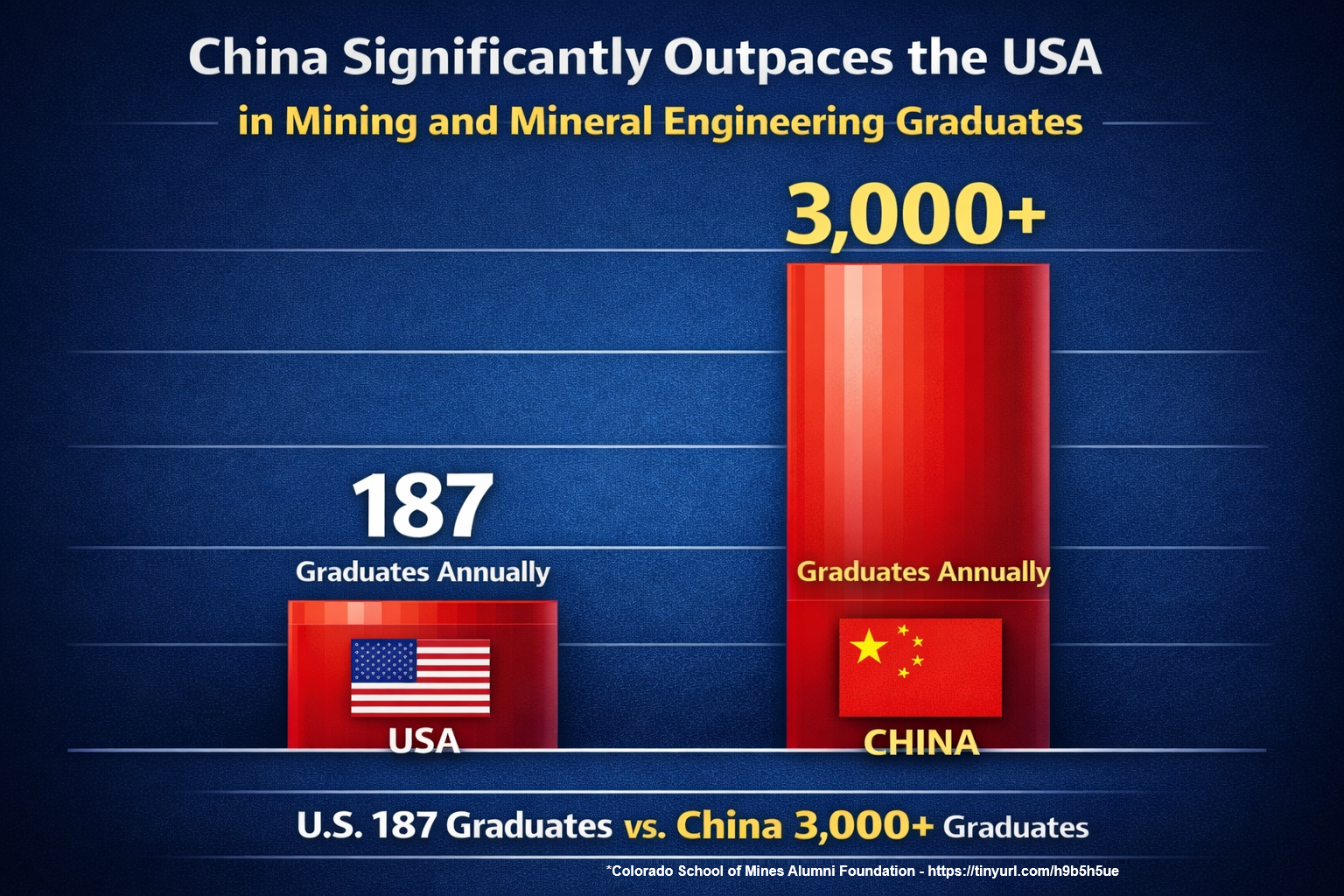
China currently operates roughly 45 mining engineering programs that collectively enroll about 12,000 students and graduate approximately 3,000 mining engineers per year.121
China is graduating roughly sixteen times more mining engineers each year than the United States.
The United States, by contrast, has just 14 mining engineering programs. As of spring 2023, these programs collectively enrolled only 590 undergraduate students and graduated less than 200 mining engineers nationwide.1
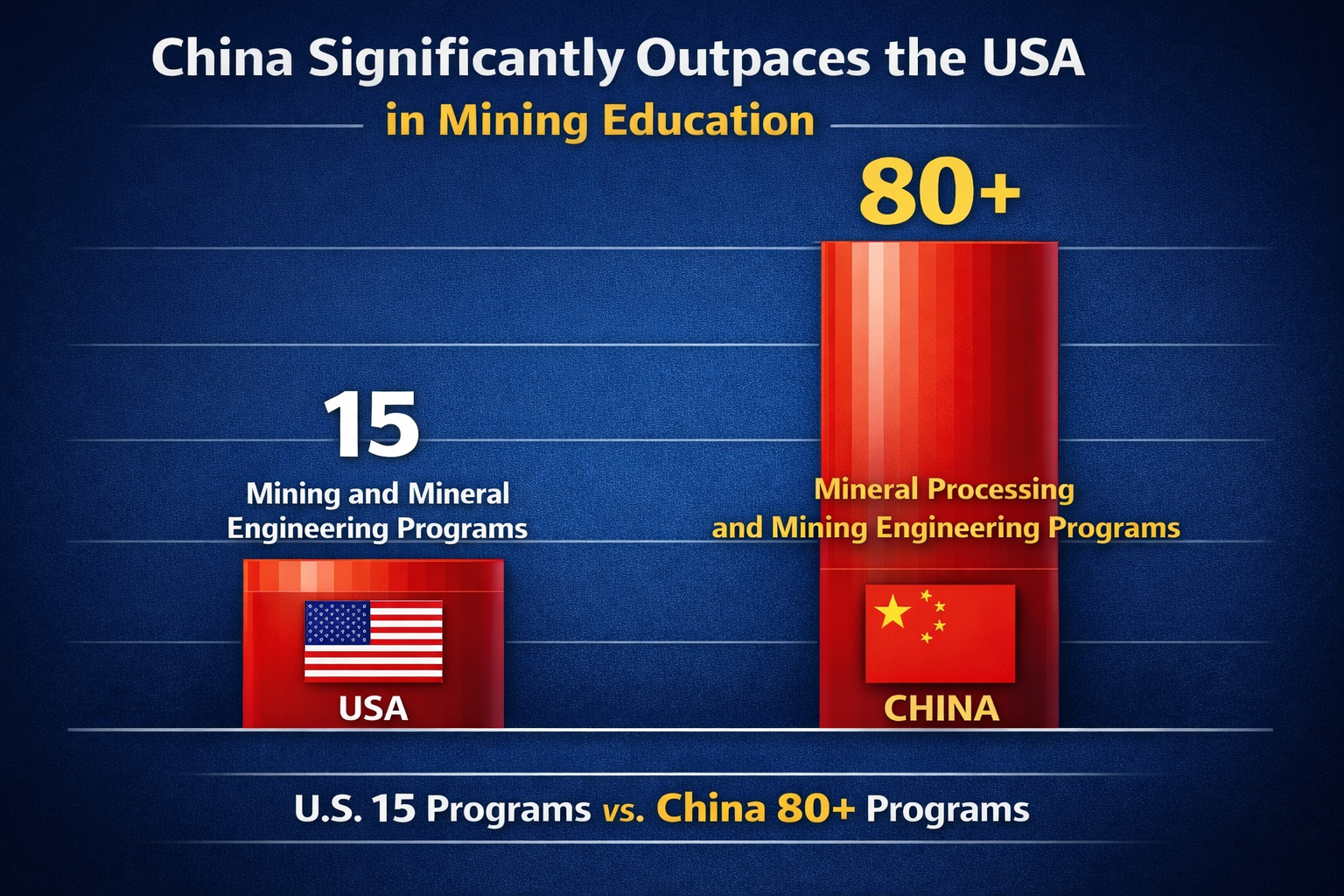
U.S. enrollment in mining engineering programs has fallen nearly 60 percent since 2015.3
That disparity should alarm anyone concerned about America's economic competitiveness or national security.
Mining Is Not Optional
Mining is not optional. Every electric vehicle requires roughly four times more copper than a conventional vehicle.10 Grid expansion, renewable generation, AI data centers, and domestic manufacturing all depend on steady supplies of mined materials.
Yet America now imports more than 50 percent of its copper.4

Copper prices have effectively doubled over the last six years—rising from under $3 per pound in early 2020 to record highs exceeding $6 per pound by January 2026.5 Demand from EVs, AI, and grid modernization is accelerating faster than domestic supply.
Higher electricity prices, rising infrastructure costs, and growing dependence on foreign minerals are not separate problems. They are symptoms of the same failure: a shrinking domestic mining workforce.
Nearly two-thirds of mining CEOs say skills shortages will have a large or very large impact on profitability over the next decade.6
Mining executives recognize the threat. More than half cite recruitment challenges as the biggest barrier to adopting new technology.7
At the same time, the perception problem is severe. Roughly 70 percent of people aged 15–30 say they would probably or definitely not consider a career in mining. Only 4 percent say they definitely would.8
A Workforce Perception Problem
The United States does not have a mineral shortage. It has a workforce perception and exposure problem.
Most workforce strategies focus on universities. But by the time mining companies arrive on campus with recruiting booths and signing bonuses, the talent decision has largely already been made.
According to the University of Arizona's Department of Mining and Geological Engineering, roughly 80 percent of surveyed college freshmen had already decided on a major within the first three weeks of their first semester.9
In other words, by the time companies begin recruiting engineering students, most students have already chosen—or avoided—fields like mining.
.png)

If America wants more mining engineers, geologists, and metallurgists, exposure cannot begin in college. It must begin earlier.
High Schools: The Scalable Solution
High schools represent the largest and most scalable point of influence in the talent pipeline. America's 16 million high school students cannot pursue careers they have never seen.
Today's teenagers encounter endless content about software startups, influencers, and tech giants.
Very few ever meet a mining engineer. Fewer still learn that modern mining involves robotics, automation, electrified equipment, environmental monitoring, water recycling, geospatial modeling, and advanced materials science.
The result is predictable.
Students self-select out long before they understand what the industry actually offers.
This is not a theoretical idea. Platforms now exist that make early career exposure fast, inexpensive, and scalable.
It is worth repeating: each year, China is graduating 16 mining engineers for every one we graduate in the United States.
This statistic keeps me up at night—and it is a primary reason my firm developed Career Invites™, a platform designed to help high school students discover mining, energy, and skilled trades careers earlier, before those career paths are unintentionally closed off.
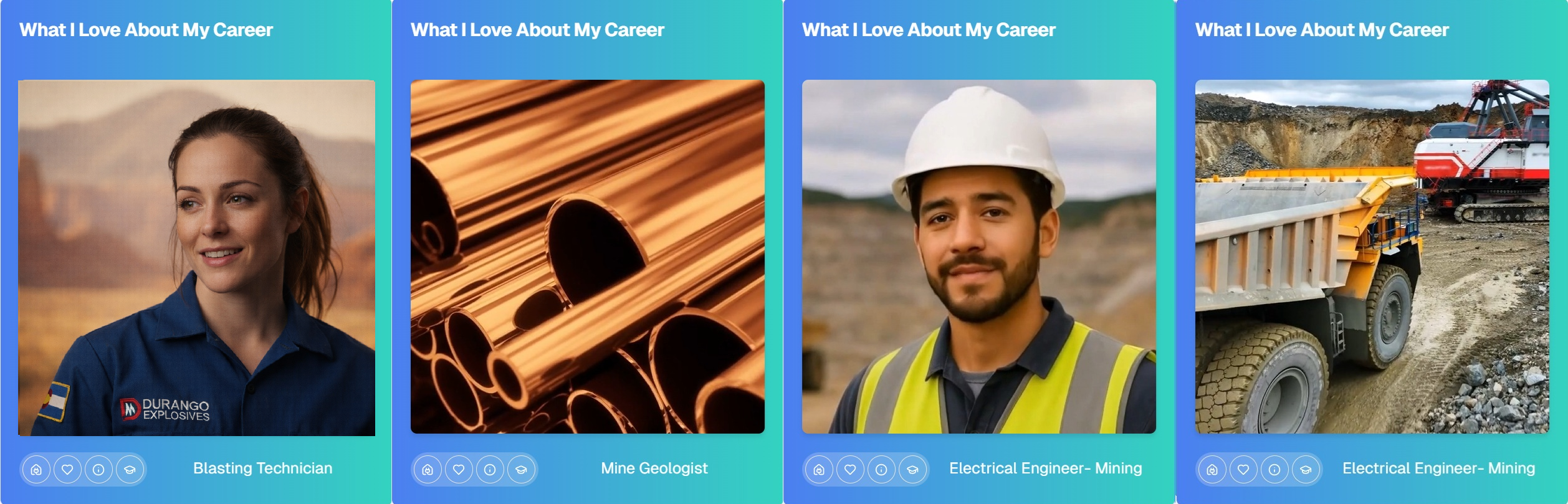
Imagine if every high school student could:
- •Spend just 20 minutes exploring short videos of real mining professionals explaining what they love about their work
- •See what a typical day looks like in modern mining operations
- •Learn what training is required for various mining careers
- •Understand how their job supports clean energy, infrastructure, and national defense
Imagine if teachers had ready-to-use lesson plans that connect chemistry, physics, geology, and engineering to real careers.
Imagine if mining companies could share their career pathways directly with students instead of competing for the same small pool of graduates at the end of the funnel.
That is a radically cheaper and more scalable approach than endlessly increasing recruiting spend, signing bonuses, fly-in fly-out rotations, and bidding wars for scarce talent.
A small investment in early awareness multiplies the size of the future workforce.
Workforce Is Everything
Workforce is a permitting issue.
Workforce is a financing issue.
Workforce is a national security issue.
Industry leaders estimate that hundreds of new mines will be required globally to meet future mineral demand. The United States cannot build and operate those mines without dramatically expanding its domestic workforce.
No amount of capital will compensate for the absence of people.
The Choice Is Clear
America can continue competing for a shrinking pool of mining talent.
Or it can start growing a much larger one.
The mining workforce choices we make today will determine America’s energy abundance, economic prosperity, and national security.
Sources & References
1. U.S. Mining Engineering Enrollment & Graduates
National Academies of Sciences, Engineering, and Medicine (2024). Building Capacity for the U.S. Mineral Resources Workforce: Proceedings of a Workshop.
https://doi.org/10.17226/277762. China Mining Engineering Programs & Graduates
Kecojevic, V. (Society of Mining Professors); Society for Mining, Metallurgy & Exploration (SME). Cited in National Academies Workshop Proceedings (2024).
3. Decline in U.S. Mining Engineering Enrollment Since 2015
National Academies of Sciences, Engineering, and Medicine (2024).
https://doi.org/10.17226/277764. America Imports Over 50% of Copper
U.S. Geological Survey (USGS), Mineral Commodity Summaries: Copper (2024).
https://www.usgs.gov/centers/national-minerals-information-center5. Copper Price Increase
World Bank Commodity Price Data ("Pink Sheet"); London Metal Exchange (LME).
6. Mining CEOs Concerned About Skill Shortages
PwC (2023). Mine 2023: The Rise of the Intelligent Mine.
https://www.pwc.com7. Recruitment Biggest Barrier to Technology Adoption
PwC (2023). Mine 2023.
8. Youth Reluctance to Work in Mining
McKinsey & Company (2022). The Future of the Mining Workforce.
https://www.mckinsey.com9. College Students Choose Major Early
University of Arizona, Department of Mining & Geological Engineering.
10. EVs Require Significantly More Copper Than ICE Vehicles
International Energy Agency (IEA). The Role of Critical Minerals in Clean Energy Transitions.
https://www.iea.org